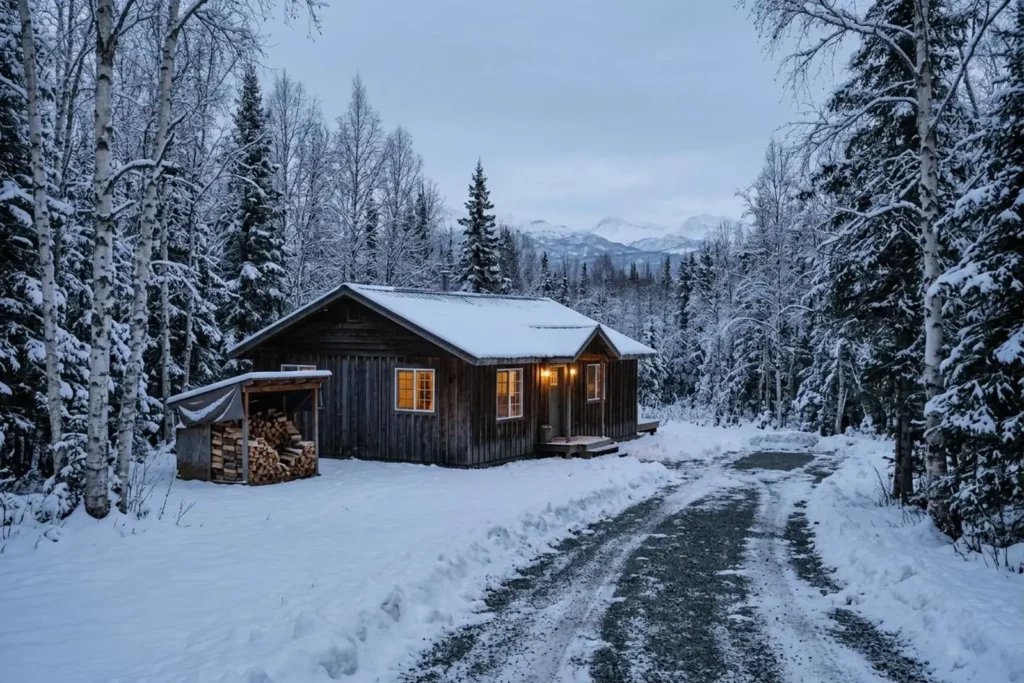
Winterizing a home in the Mat-Su comes down to five systems: the heat, the pipes, the well and septic, the roof, and the driveway. Get each one ready before the cold settles in. Here is what to check, which local rules apply, and what to do when the power goes out.
Why winterizing a home in the Mat-Su starts in the fall
NOAA’s 1991–2020 climate normals for the Palmer airport put the average January high at 22.4°F and the average low at 8.3°F, and cold snaps run well below that. Wasilla gets roughly 5 hours and 19 minutes of daylight at the December solstice, so checks you put off happen in the dark.
Walk the house in September or October with the checklist below, then again after the first real snow. New to the Valley? Our moving to Alaska guide covers the rest of the first-winter adjustments.
Heat: service the system and know your fuel
Have the furnace or boiler serviced before you need it, and learn how your fuel behaves in the cold.
- Heating oil. The University of Alaska Fairbanks Cooperative Extension Service notes that #2 diesel begins to congeal at 20 above and colder, and that even #1 heating oil stops flowing well at around minus 60. Ask your supplier which grade you get.
- Propane. Liquid propane turns to gas at minus 44°F. When the tank contents get that cold, gas cannot reach your appliances, according to the same Extension guide.
- Natural gas. ENSTAR asks customers to keep snow and ice off the meter and regulator using a broom or soft brush, never a shovel or snowblower, and never to kick the meter to knock ice loose. Snow off a roof or a plow can bury a meter and damage it. Keep a path clear for emergency crews.
Oil tank checks
The Alaska Department of Environmental Conservation (DEC) tank inspection guide lists these winter checks:
- Look for ice, snow or limbs that could fall on the tank or fuel lines, including snow sliding off the roof.
- Keep the tank vent clear of snow, ice and insects.
- Check for water in the tank. It corrodes the tank from inside and can crack the fuel filter in cold weather.
- Watch your fuel use. A sudden jump, or a diesel odor near the tank or in the crawlspace, can mean a leak.
DEC’s after-hours spill line is 1-800-478-9300.
Chimneys, flues and carbon monoxide
Deep cold can block a chimney with frost. The Extension guide recommends a properly sized chimney brush, and removing a rain cap during a cold period if frost blockage is a problem.
Alaska law (AS 18.70.095) requires carbon monoxide alarms in every qualifying dwelling: one with a fuel-burning appliance, an attached garage or carport, or an adjacent parking space. Install them following the manufacturer’s instructions. UAF Extension advises placing alarms at breathing level on every floor and near sleeping areas. Test them when you service the heat.
Pipes: keep the water warm and moving
Frozen pipes usually start somewhere cold: a crawlspace, an outside wall or an unheated garage. The UAF Extension guide recommends:
- Insulate pipes in unheated areas under or outside the house, and keep the space under the house enclosed.
- Leave cabinet doors open on outside walls so room heat reaches the pipes.
- During a cold snap, let a faucet drip, but catch the water in a bucket instead of letting it run down the drain. A slow trickle can freeze in the drain line.
- To thaw a frozen supply line, warm it with a hair dryer. Never put electric heat tape on a fuel line.
Heat tape needs care. The Extension guide cites a U.S. Consumer Product Safety Commission estimate of 2,600 fires a year involving heat tapes, often from improper installation. Follow the manufacturer’s instructions and replace tape with damaged insulation.
Leaving a house unheated? Extension’s checklist: drain the pipes by opening the valves at the lowest points, flush the toilet after the water is off, put nontoxic (propylene glycol) antifreeze in sink, tub and toilet traps, turn off the main electrical switch, and let your utilities know.
Well and septic
Many Valley homes run on a private well and septic system. If the pressure tank, pump controls or supply line sit in a well house or crawlspace, that space needs reliable heat. UAF Extension mentions a simple option for a short exposed run: an incandescent bulb hung inside an enclosure big enough for air to circulate around the pipe.
Fall is also a good time to pull your well log from the state’s WELTS database so you know the depth before something goes wrong. The state does not require private well testing, but DEC recommends annual coliform bacteria and nitrate tests, plus arsenic in some areas, at a state-certified lab. Keep vehicles and plowed snow piles off the septic tank and drainfield.
Buying a home with a well and septic? Our cabins for sale in Alaska guide covers what lenders ask for.
Roof: snow load and ice dams
After heavy snow in the 2022–23 winter, the Mat-Su Borough’s emergency services director recommended hiring a contractor to clear roofs, and pointed residents to FEMA’s warning signs of an overloaded roof. As reported by the Frontiersman, they include:
- Sagging ceilings or roof lines
- Popping, cracking or creaking noises
- Doors and windows that suddenly will not open or close
- New cracks in walls or masonry
- Severe roof leaks
The same guidance says to leave about two inches of snow on the roof, use plastic shovels, skip sharp tools and machines, and use a non-metallic roof rake from the ground where you can.
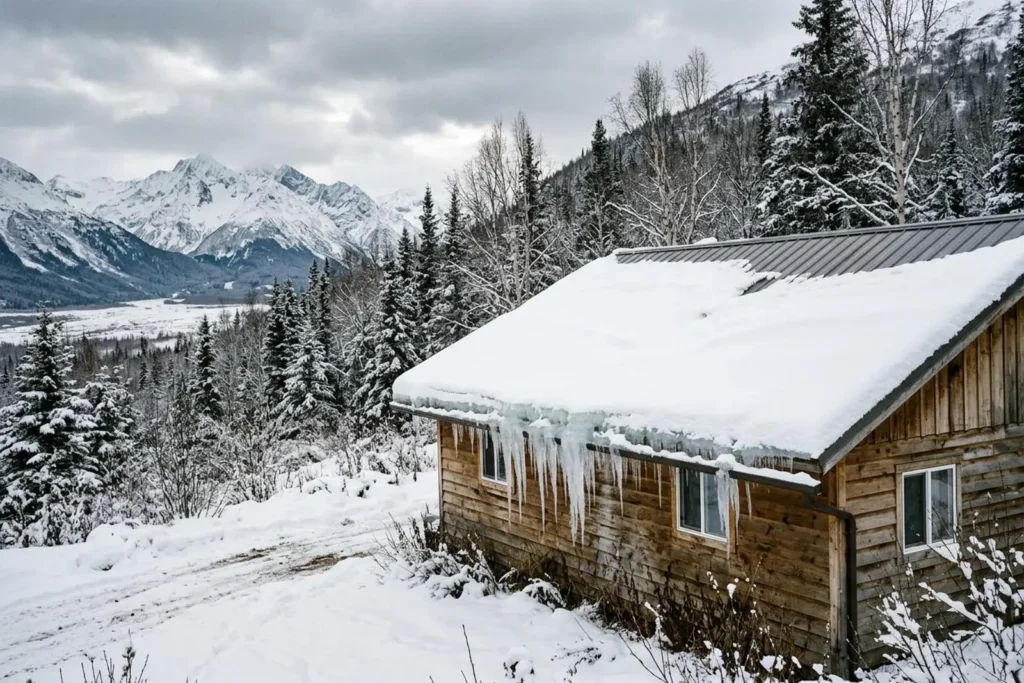
Ice dams form when roof snow melts during the day and refreezes at the cold edge overnight, according to the National Weather Service. Meltwater can back up under the shingles into the attic and ceilings. NWS recommends clean gutters, a roof rake, enough attic insulation, and airflow from the soffits out through the roof vents. An energy rating can show where heat is reaching the roof.
Driveway and road: who plows what
The road in front of your driveway may be the borough’s, a city’s, the state’s or private, and that decides when it gets plowed. The Mat-Su Borough maintains roads through 16 road service areas. Its road maintenance page says:
- Plowing begins when snow reaches 4 inches and normally finishes within 48 hours after snowfall stops.
- School bus routes come first, then primary collector roads, then secondary and subdivision roads.
- Crews try to keep the berm across a driveway to one foot or less, but clearing the berm is the property owner’s job.
- It is illegal to plow private snow onto or across the road surface.
The Anchorage Daily News reported in November 2023 that the borough sends two warning letters to owners documented pushing snow into roads, followed by a citation with a $150 fine. The City of Wasilla also prohibits pushing or blowing snow into the roadway. Pile snow on your own lot, away from the meter, tank and septic.
Borough road questions go to the Road Maintenance Hotline, 907-861-7755. If your road is private, find out who plows it before the first storm. Our Big Lake guide explains how private roads become borough-maintained.
Power outages: plan for a long one
Outages here can last days. In the December 2025 windstorm, gusts reached 84 mph in Palmer and nearly 21,000 Matanuska Electric Association (MEA) customers lost power at the peak, according to Alaska’s News Source.
- Report outages to MEA at 907-746-7697 (Eagle River: 907-696-7697) or through SmartHub.
- Never wire a generator into the house without a proper switching setup. MEA warns that backfeed through the meter can injure or kill line crews.
- Run generators outdoors only, never in an attached garage, even with the door open (UAF Extension).
- Keep the freezer closed. MEA says food can stay frozen for 24 hours or more.
- Keep anything flammable at least three feet from space heaters, and never heat the house with a stove or oven.
A backup heat source that runs without power, such as a wood stove, is worth having. Check its chimney now.
Buying or selling a home in winter
Winter shows how a house really performs. Buyers should ask for heating costs and records of any frozen pipes, ice dams or roof work. The state’s seller disclosure form asks about frozen lines, among other Alaska-specific items.
Selling a vacant home? If your buyer uses an FHA loan, HUD’s handbook requires heat that keeps living areas at 50°F automatically, without anyone tending it. Keep the heat on and the pipes protected while it is listed. Our home selling page covers how we prepare a listing, and you can browse what is on the market now on our live map search.
For upgrades, the Alaska Housing Finance Corporation offers energy ratings, a renovation loan and interest rate reductions, plus weatherization for income-eligible households.
Fall winterizing checklist
| System | Before the cold |
|---|---|
| Heat | Service the system, confirm the fuel grade, test CO alarms |
| Pipes | Insulate exposed runs, check heat tape, find the main shutoff |
| Well and septic | Test the well house heat, pull the well log, mark the drainfield |
| Roof | Clean gutters, get a roof rake, check attic insulation and vents |
| Driveway | Learn who plows your road, plan where your snow goes |
| Outages | Stock a kit, check backup heat, confirm generator switching |
Buying or selling in the Mat-Su this winter? Alaska Realty & Investments can help you ask the right questions about heat, water, roof and road access before you commit. Contact us, or call or text 907-414-0946.
Frequently Asked Questions
When should I winterize my home in Alaska?
In the Mat-Su, do it in September and October, before temperatures stay below freezing and while there is daylight to work. Service the heat, insulate exposed pipes, clean the gutters, check the well house and find out who plows your road. Walk the house again after the first real snow.
How do I keep pipes from freezing in an Alaska house?
Insulate pipes in crawlspaces and outside walls, keep the space under the house enclosed, and open cabinet doors on cold walls. In a cold snap, let a faucet drip into a bucket, not the drain. Use heat tape only as the manufacturer directs, never on fuel lines. Thaw a frozen supply line with a hair dryer.
Is it illegal to plow snow into the road in the Mat-Su?
Yes. The Mat-Su Borough says it is illegal to plow private snow onto or across the road surface, and the City of Wasilla also prohibits it. Under a policy reported in November 2023, the borough sends two warning letters before a citation with a $150 fine. Keep the snow from your driveway on your own lot.
Does Alaska require carbon monoxide detectors?
Yes. AS 18.70.095 requires carbon monoxide alarms in qualifying dwellings, which UAF Extension describes as homes with an attached garage or an installed fuel-burning appliance, such as a furnace, boiler or wood stove. Place alarms at breathing level on every floor and near sleeping areas, and test them each fall.
How much snow can my roof hold?
It depends on how the roof was designed and built, so there is no single number. Watch for warning signs instead: sagging ceilings, cracking or popping sounds, sticking doors and windows, and new wall cracks. The Mat-Su Borough’s emergency services director has recommended hiring a contractor to clear a roof, and a non-metallic roof rake helps from the ground.
Sources
- NOAA National Centers for Environmental Information: U.S. Climate Normals 1991–2020, Palmer Airport (USW00025331)
- NOAA Global Monitoring Laboratory: Solar Calculator
- University of Alaska Fairbanks Cooperative Extension Service: Keeping Your House Operating During a Cold Alaska Winter (EEM-04955)
- Alaska State Legislature: AS 18.70.095, Smoke and carbon monoxide detection devices
- University of Alaska Fairbanks Cooperative Extension Service: Carbon Monoxide: A Silent Killer (RAD-00756)
- ENSTAR Natural Gas: Removing Snow and Ice
- Alaska Department of Environmental Conservation: Aboveground Heating Oil Tank Inspection Guide
- Alaska Department of Environmental Conservation: Alaska Heating Oil Tanks: A Guide for Homeowners
- Alaska Department of Environmental Conservation: Private Drinking Water Wells and Systems
- Alaska Department of Natural Resources: Well Log Tracking System (WELTS)
- Frontiersman: Snow load removal and safety guidance
- National Weather Service: Preventing Roof Ice Dams
- Matanuska-Susitna Borough: Road Maintenance
- Anchorage Daily News: Mat-Su home snow removal scofflaws now receiving warning letters
- City of Wasilla: Winter Road Maintenance
- Matanuska Electric Association: Power Outages
- Alaska’s News Source: Windstorm leaves thousands without power in the Mat-Su Valley
- U.S. Department of Housing and Urban Development: FHA Single Family Housing Policy Handbook 4000.1
- Alaska Real Estate Commission: Residential Real Property Transfer Disclosure Statement (08-4229)
- Alaska Housing Finance Corporation: Energy Efficiency